High-quality visuals have become essential in today’s digital landscape. Whether you’re managing a business website, running social media campaigns, selling products online, or building a personal portfolio, the quality of your images can directly influence how audiences perceive your content. Clear, professional-looking visuals attract attention, build credibility, and encourage engagement. As competition for online visibility…
Creator platforms succeed when they solve the two-sided cold-start problem, align their revenue model with creator success, and offer audience ownership that professional creators trust. Here is why.
Reddit’s organic search traffic grew 603% between 2023 and 2025 following Google’s $60 million data partnership. Here is how Reddit affects search rankings and what it means for content strategy.
Entity SEO is the practice of making your content and brand legible to Google as clearly defined things with attributes and relationships, not just collections of keywords. Here is how it works.
Websites lose traffic after Google updates when ranking signals are recalibrated against content quality, E-E-A-T, technical performance, and search intent. Here is why it happens and how to respond.
Brave Browser blocks ads and trackers by default, routes private windows through Tor, and is open source — but it has a notable controversy history worth knowing before you switch.
Google provides tools to remove personal data from search results, but lasting privacy requires tackling data brokers at the source. Here is a complete step-by-step guide.
Signal encrypts all messages by default and collects almost no data. Telegram stores cloud chats on its servers and only encrypts in optional Secret Chats. Here is the full comparison.
Zero-click search now accounts for 65% of all Google queries. Here is what drives it, what the data shows about AI Overviews and CTR decline, and what actually still generates clicks.
Coomer gets millions of searches every month but most sites covering it either say too little or get it completely wrong. This guide explains what the website is, how it works, why it runs slow, whether it is safe, and what alternatives actually work in 2026.
What Is Coomer?
Coomer is a third-party content archiving platform that indexes and mirrors posts from creator-based subscription services. This platform does not run its own subscription-based system, neither it processes payments, or manage creator accounts. What it does is pull content that has already been published on platforms like OnlyFans, Fansly, and Patreon and organise it so anyone can browse it without holding an active subscription on the source platform.
The platform is built around a directory structure. Content is sorted by creator name and source platform, which makes finding specific creators quick and straightforward. This focused approach to creator content archiving is what sets it apart from broader web archive tools.
Two versions come up constantly in searches. Coomer.su is the primary domain the platform has run on for most of its history. Its full story, current status, and how it operates is in the Coomer.su article. Coomer Party is a separate variation with its own indexing structure, covered in full on the Coomer.Party page.
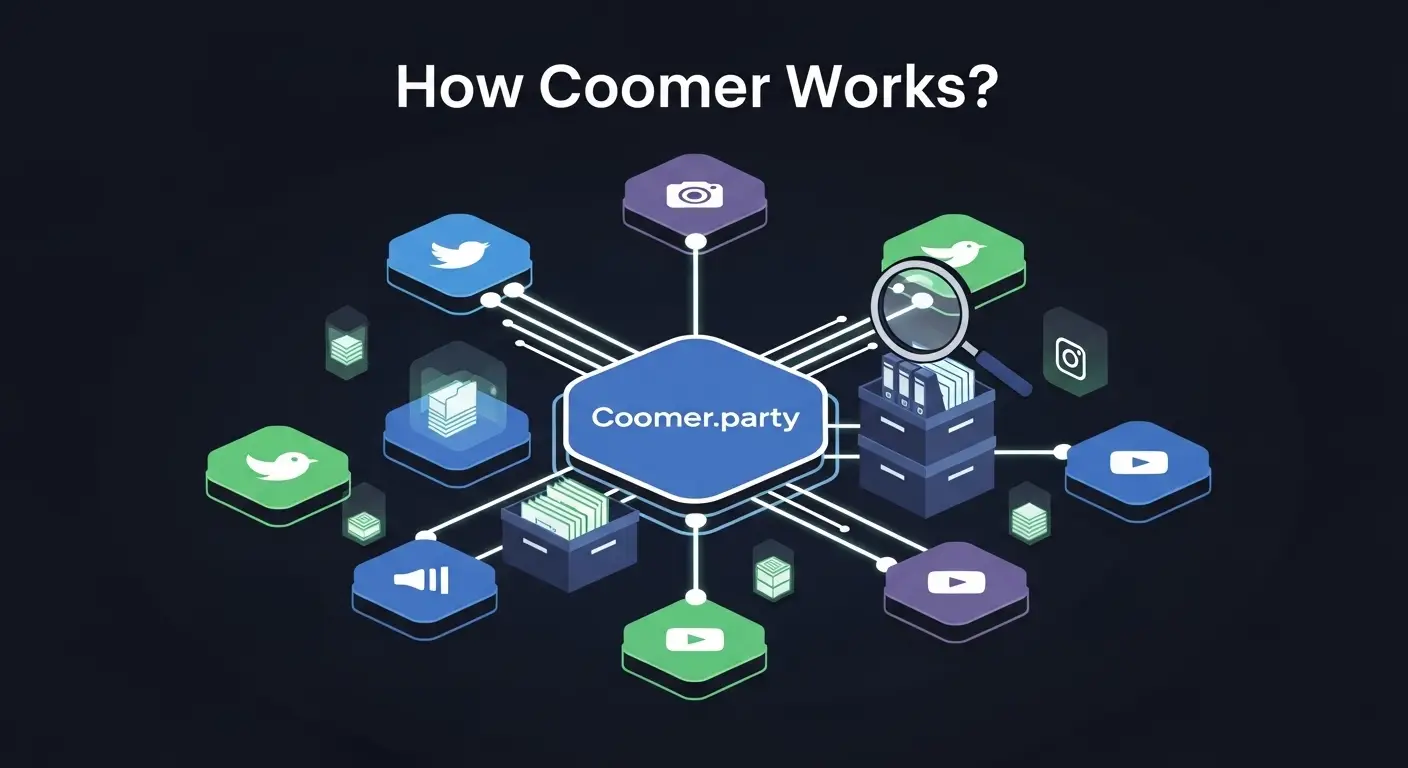
How Coomer Works?
Coomer works as a content mirror. It pulls and displays data from other platforms rather than creating anything of its own.
How Content Gets Archived and Updated
The platform runs automated crawlers that index posts from supported subscription services. Once indexed, content is organised by:
Creator name — search any indexed creator directly by username
Source platform — filter by where the content was originally posted
Post date — browse a creator’s archive in chronological order
File type — images and videos are separated in most views
This directory-style structure makes this platform one of the more straightforward third-party content aggregators to navigate. You search for who you want and the directory gets you there without extra steps.
Why Updates Can Be Delayed
Coomer does not pull new content in real time. When a creator’s profile looks outdated, these are the usual reasons:
Server load — heavy traffic slows crawling schedules
Crawler queues — indexing jobs back up during peak periods
Source platform changes — structural updates on OnlyFans or Fansly can temporarily break indexing
Downtime recovery — after an outage, update cycles reset and take time to catch up
This is normal behaviour for asynchronous content archiving systems. It is not a sign something is broken.
Why Is Coomer So Slow — And How to Fix It
Slow loading is the most reported problem with Coomer. The platform serves high-resolution images and video files across thousands of creator profiles at the same time. Its server infrastructure regularly struggles to keep up with that demand, especially during peak hours.
How to Make Coomer Videos Load Faster
Fix
Why It Works
Switch to a wired connection
Reduces latency compared to Wi-Fi
Clear your browser cache
Removes stored data conflicting with media loading
Use a lightweight browser
Less processing overhead on your end
Try a VPN
Can route traffic through faster server paths in some regions
Access during off-peak hours
Lower server demand produces faster response times
How to Fix Buffering Issues
Buffering on the website is almost always a server-side problem rather than something wrong with your connection. These approaches work consistently:
Pause the video and let it buffer for 30 to 60 seconds before playing
Access the platform during early morning UTC when server traffic is lower
Lower the video quality setting where the option exists
Turn off browser extensions that interfere with media streaming
Is Coomer Down Right Now?
Coomer goes down more often than mainstream platforms. It operates outside major commercial hosting infrastructure so outages can happen without warning and sometimes last several hours.
How to Check and Fix Access Issues
To Fix access issues follow these simple steps:
Step 1
Check if it is down for everyone: Run the domain through Downdetector, IsItDownRightNow, or DownForEveryoneOrJustMe to confirm whether it is a platform-wide problem or just you.
Step 2
Fix local access issues: If others can reach it fine, the problem is on your end. Clear your DNS cache or switch to a public DNS resolver:
Google DNS: 8.8.8.8
Cloudflare DNS: 1.1.1.1
Step 3
Try a different browser or network: Sometimes a browser cache issue or an ISP-level block is the cause. Switching to mobile data quickly confirms whether that is the case.
Step 4
Wait it out: If it is down platform-wide then it will recover on its own. Domain-level disruptions take longer than standard server outages to resolve.
Is Coomer Safe?
Yes, Coomer is safe to use if you take a few straightforward precautions. The platform does not require downloads or account registration, which removes two of the most common risk factors with sites of this type.
The three areas worth paying attention to are:
Risk Area
Level
What to Do
Third-party ads
Medium
Use an ad blocker
Privacy and IP exposure
Medium
Use a VPN
Legal and copyright
Varies by country
Check your local laws
Ads are the most immediate concern. Some versions of the platform serve aggressive ad networks that include misleading download buttons and redirects. An ad blocker clears most of this before it becomes a problem.
Privacy is straightforward. The website does not need your personal information to use it but your IP address is still visible to the platform’s servers. A VPN handles this if it matters to you.
Legal exposure depends on where you are. Accessing archived subscription content sits in a grey area in many jurisdictions. It is worth a quick check on your country’s position before using the platform regularly.
How to Use Coomer?
You can use Coomer straight from your browser. No account needed, no subscription required, nothing to download or install. Open the site, search for a creator by name or browse by source platform, and their indexed profile loads straight away.
The 5 basic steps are:
Open Coomer in any standard browser
Search by creator name or filter by source platform
Open a creator profile to view their archived posts
Sort by file type or post date to find what you need
Save individual files using standard browser functions
For a full walkthrough including how to handle access issues, filter results, and navigate Coomer.su versus Coomer Party, the complete Coomer user guide covers everything step by step.
How to Download from Coomer?
Coomer does not have a built-in bulk download feature across all versions, which is why it is one of the most searched topics about the platform. Here is how downloading works depending on what you need:
Method
Best For
Limitation
Browser right-click save
Single files
One file at a time
Third-party batch tools
Multiple files from one profile
Requires separate tool setup
Browser download manager
Queued individual downloads
Slower than batch tools
For a full breakdown of which tools work reliably, how to handle failed downloads, and what to know about file formats, the Coomer download guide has the complete process.
What Happened to Coomer?
Coomer has gone through repeated takedowns, domain changes, and hosting disruptions over its operational history. The reasons come up consistently:
DMCA actions filed by content creators and subscription platforms
Hosting terminations after platforms came under legal pressure
Domain migrations from Coomer.party to Coomer.su and other variations
Copyright enforcement from subscription services protecting creator content
The tension is structural. A platform that archives subscription content is in direct conflict with the intellectual property rights of the creators it indexes. That has made it a consistent target for legal action. Despite repeated disruptions it has continued to reappear under new domains. The full timeline and current status are on the What Happened to Coomer page.
Best Coomer Alternatives – Top 5 Similar Sites in 2026
Platform
Type
Account Required
What Makes It Different
Kemono.su
Creator content archiving
No
Closest working alternative
Patreon
Creator subscriptions
Yes
Official platform, supports creators directly
Fansly
Creator subscriptions
Yes
Official, strong creator privacy controls
Archive.org
General web archiving
No
Broad scope, not creator-specific
F95Zone
Community content sharing
Yes
Community-run, moderated
Frequently Asked Questions (FAQs)
Coomer refers to a content archiving platform that gathers and organises material from creator subscription services, allowing users to browse it in a directory-style format without direct interaction with the original platform.
Yes, it works on any standard mobile browser without an app or installation. Video loading on mobile is slower than desktop because of how the platform serves media files. Switching to Wi-Fi instead of mobile data improves performance noticeably. The browsing and search experience is otherwise the same as desktop.
Yes, creators can submit DMCA takedown requests to have specific content removed. Removal is not always immediate and content can reappear after a domain migration or re-indexing. Direct legal action against the platform’s hosting infrastructure has been the more effective route for permanent removal.
Coomer indexes content on automated schedules rather than in real time so creator profiles regularly lag behind the source platform. This is a normal characteristic of how the archiving system works. There is no way to manually trigger a profile update from the user side.
The platform itself does not install anything on your device. Risk comes from third party ad networks that some versions run, which can serve misleading download prompts. An ad blocker removes this risk before it becomes a problem.
Both archive creator subscription content without requiring user accounts. Kemono covers a broader range of platform types while Coomer has historically focused on specific subscription services. Kemono.su is currently the more stable of the two.
No. Coomer.org.uk is an independent information resource covering the platform. It is not operated by or connected to the original Coomer service in any way.
No. Coomer Party was the original domain while Coomer.su is where the platform moved after facing takedown pressure. They are the same platform operating under different domains at different points in time.